
Beyond the Needle: How to Unlock Your Body’s Natural GLP-1 Factory
By Xucheng Zhang, BS
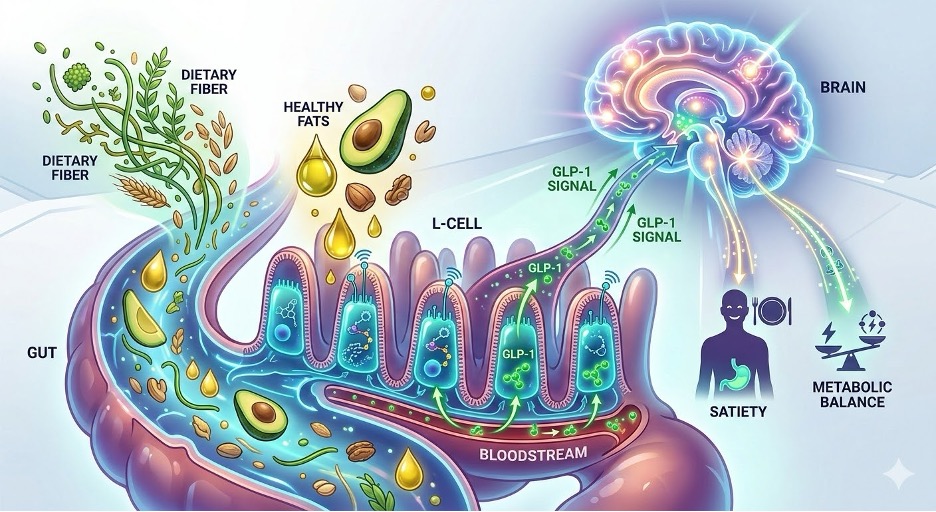
Look closely at the detailed schematic above. You’re looking at a biological masterclass: the blueprint of a high-tech, highly efficient “internal pharmacy” that lives right inside your gut. Those blue-green cellular factories, labeled L-cells, are already poised to manufacture a powerful biological signal called GLP-1. That signal, as the chart shows, travels straight from your gut to your brain, unlocking two of the most sought-after effects of modern health: persistent Satiety and true Metabolic Balance.
When we talk about the “miracle” of blockbuster medications like Ozempic and Wegovy, we are discussing substances designed to mimic this precise natural process. While everyone is talking about silencing “food noise” and feeling full, few realize they already possess the necessary equipment. The true secret isn’t finding a needle-based prescription; it is providing your L-cells with the specific, natural “raw materials” they need to get to work.
“The best pharmacy is often not the one on the corner, but the one inside your digestive tract,” says a Stanford Lifestyle Medicine researcher. “By choosing the right nutrients, you aren’t just eating; you are sending a biological text message to your brain that says, ‘I am satisfied.’”
The Secret Sauce: 3 Nutrients That Trigger Your Inner GLP-1
To turn on your internal GLP-1 factory, you need to target the “sensors” on your L-cells. Here is how to do it with your fork:
1. The Fiber “Fuel” (Barley and Oats)
L-cells are most concentrated at the end of your intestinal tract. Most foods are absorbed before they get there, but Fiber is different. It travels all the way down, where gut bacteria ferment it into short-chain fatty acids (SCFAs). These SCFAs are like the “start” button for GLP-1 release.
- The Pro Move: Switch your morning toast for a bowl of barley or steel-cut oats. They are packed with beta-glucan, a sticky fiber that ensures a slow, steady release of GLP-1 that can last all day.
2. The Protein & Calcium “Combo”
Protein is the king of satiety. When you eat protein, it triggers a “satiety cascade.” Even better? Combine it with calcium.
- The Pro Move: Reach for Greek yogurt or cottage cheese. Research suggests that the combination of amino acids and calcium makes L-cells significantly more “talkative,” helping you stay full for hours longer than a carb-heavy snack.
3. Healthy Fats (The Olive Oil Strategy)
Not all fats are created equal. While saturated fats (like butter) are “quiet,” monounsaturated fats—like those in Extra Virgin Olive Oil and Avocados—are loud signals for GLP-1 production.
- The Pro Move: Drizzle olive oil generously over your vegetables. It sensitizes your gut to satiety signals, making every bite more satisfying.
The Stanford “Fe-Fi-Fo” Lesson: Diversity Matters
You might wonder: If I just eat a ton of fiber tomorrow, will I be a GLP-1 machine? Not necessarily.
As Stanford’s Fe-Fi-Fo (Fermented vs. Fiber) study recently highlighted, your gut needs to be “primed.” If your microbiome isn’t diverse, all that fiber might just cause bloating.
- The Strategy: Incorporate fermented foods like kimchi, kefir, or sauerkraut alongside your fiber. Think of it as “hiring the workers” (microbes) before “sending the materials” (fiber) to the GLP-1 factory.
3 Simple Hacks to Boost GLP-1 Today
If you want to start seeing results without a complete diet overhaul, try these Stanford-approved lifestyle hacks:
- Change Your Order: Eat your fiber (veggies) and protein (meat/beans) before your carbohydrates (rice/pasta). This “pre-loads” your L-cells and smooths out your blood sugar response.
- The “Cold Potato” Trick: Cooked and then cooled starches (like potato salad or leftover rice) develop Resistant Starch. This type of starch resists digestion and goes straight to the distal gut—the “sweet spot” for GLP-1 production.
- Prioritize Sleep: Just one night of poor sleep can plummet your GLP-1 levels and spike your hunger hormones. Metabolism is a 24-hour job!
The Bottom Line
In this “age of the needle,” it’s easy to forget that we have immense power over our own biology. While medication is a vital tool for many, the foundation of metabolic health will always be Lifestyle Medicine. By choosing foods that nourish your internal GLP-1 factory, you aren’t just losing weight—you are building a more resilient, energetic, and balanced version of yourself.

