

“Happiness equals love. Full stop.”
— George E. Vaillant, MD
Why Your Social Health is the Key to a Long and Happy Life
Our social relationships may not be the first thing that comes to mind when we think of our health or “lifestyle medicine,” yet decades of research has now established the undeniable connection between social health and our physical health and overall well-being. Specifically, structural, functional, and quality dimensions of our relationships are among the strongest predictors of how well and how long we will live, with stronger associations with mortality than smoking, obesity, physical activity, and excessive alcohol consumption. The impact on our mental health and overall flourishing is no less striking: the same George Vaillant quoted above concludes the longest-running longitudinal study of adult development by saying, “The only thing that really matters in life are your relationships to other people.”
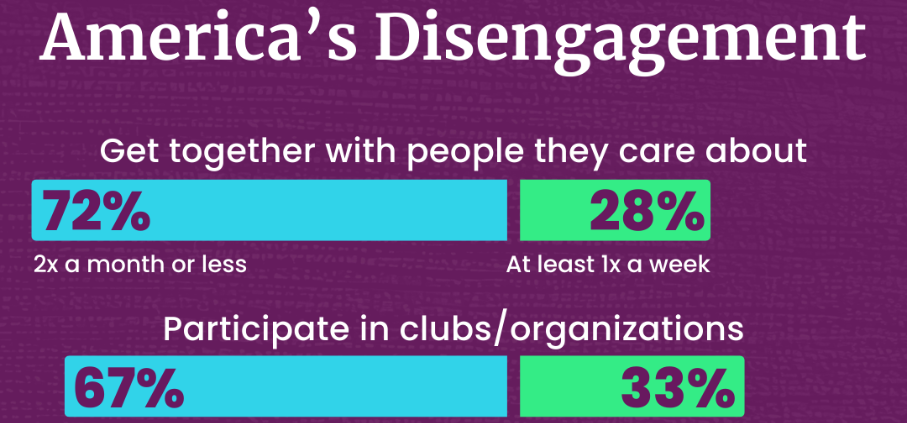
Generally, humans evolved to thrive when we each have our role to play as part of cooperative, interdependent groups of friends and relatives. That is, we need to feel we matter to others. As a highly social species, our emotional brains process disconnection as a survival threat, and if it isn’t addressed, it can become a chronic stressor, impacting our physical and mental health. For many in the modern environment, societal defaults do not provide a robust network of strong and supportive interpersonal ties. In today’s world, we need to act with intentionality to design our lives for our social health in the same way we do for our physical health.
Tips & Practices
If you want to build more connections in your local community:
Find a way to contribute. Humans naturally build relationships through interdependence and mutual support, and you can do this with groups you know already (schools, churches, etc.) or that are new to you. Every community has formal and informal opportunities to volunteer.
Play to your strengths. What do you like doing and where are your skills? Find a way to bring these attributes to a group or cause you care about, which could even be within your own family.
Start or join a project. People naturally bond when united in a shared purpose where each person has a part to play. What needs doing in your community or social circles and how can you help?
If you feel isolated or lonely:
Connect with new people through shared interests. You don’t have to have all the answers: showing up as you are to existing interest-based groups in your community is a great way to get started.
Ask for help. This could be with a therapist or support group, but even asking for a small favor from an acquaintance can open a doorway to a deeper relationship.
Go deeper with those you already know. Share your honest situation with somebody you think is trustworthy— there’s power in vulnerability. Your example invites others to do the same with you.
If you’re tight on time:
Multitask: social connection synergizes perfectly with other pillars of lifestyle medicine! Walk with a neighbor, take a healthy cooking class with a friend or meet a new one there, or talk about the latest Stanford Lifestyle Medicine newsletter with a family member.
Engage in the small acts of connection that you can do anytime: Text a friend you’re grateful for, tell people when you’re thinking of them (and for no other reason!), or initiate a get-together with a simple message.
Schedule routine social connection like you would any other priority. Do this in small ways (some social appointments each week) and with long-range planning (an annual couple’s retreat, a birthday bash, a special reunion).
Are you an introvert?
Introverts need high-quality relationships, too. You may not need as many relationships as extroverts, and you may do better with more intimate social gatherings and one-on-ones rather than a lot of large events that may leave you drained.
Connection isn’t built in a day—it’s built every day. Just like your physical health, build your social health with consistency, intention, and joy.
Further Reading








Sources
Sullivan, G., & McCarthy, M. (2019). The public health implications of the obesity epidemic. PLOS Medicine, 16(1), e1000316. https://doi.org/10.1371/journal.pmed.1000316
U.S. Department of Health and Human Services. (2023). The surgeon general’s advisory on connection in the digital age. https://www.hhs.gov/surgeongeneral/reports-and-publications/connection/index.html