
“Social Connection in America” Report Shows Grim Results
A new survey, “Social Connection in America™,” conducted by a team of researchers led by Professor Julianne Holt-Lunstad, and funded by the Barnes Family Foundation, provides a new nationwide picture of how Americans relate to one another. The “Social Connection in America™” survey was developed as a tool to provide insight and long-term direction regarding the country’s social connections. It will run for 25 years and aligns with numerous federal data sources, providing policymakers with social connection metrics that can be tracked alongside the country’s physical and mental health metrics.
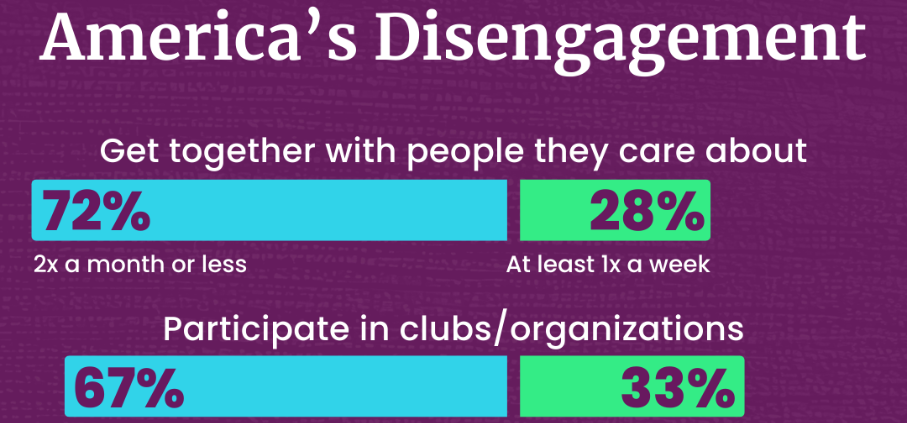
Unfortunately, the results of this year’s survey of over 10,000 US adults were troubling: 41 percent of adults say they feel lonely at least sometimes, and almost three-quarters say they get together with people they care about face-to-face only twice a month or less.
Unlike many previous surveys on social connection, this survey goes beyond loneliness to ask about structural dimensions like how many people we have in our lives, functional dimensions like social and emotional support, quality dimensions like how satisfying our relationships are, and how connected and involved we are in our local communities. This comprehensive report speaks to social connection not only as a predictor of mental health but also as an influence on physical health and longevity.
We asked Steven Crane, MS, one of the co-authors of the report, a researcher and statistician, and head of the Social Engagement Pillar of Stanford Lifestyle Medicine, to tell us more about the survey and what it means for residents of the US.
“Overall, the survey raises many red flags in the structural aspects of our social connections,” says Crane. “More and more people aren’t connecting with their relationships and communities as much as they should be to maintain their health and well-being.”
How Connected Are Americans?
It may sometimes seem that many Americans have many close friends and a strong social network; however, the survey found that Americans’ social circles are often sparse. Thirty-nine percent of adults reported having only two or fewer close relationships, while fewer than a fifth reported having six or more. On top of that, nearly three-quarters of adults said they didn’t spend time with people they cared about more than two times per month a month, and nearly one in three said they rarely (less than once a week or never) talked to people they were close to via phone or video.
The survey also showed that “no social group engagement” has quietly become the norm. More than half of all adults said they attended no clubs or organizations, did not attend religious services, volunteered no time, and got together with their neighbors to help their community zero times over the last year.
For Crane, these results reveal something much worse than simply people’s preferences for how they want to live their lives. “The results show that the US is continuing to experience a public health crisis of disconnection and isolation,” says Crane. “Rather than being an exception, disengagement has become the norm, and that has implications for the physical and mental health of our country and the resilience of our communities.”
Who Is Most at Risk—and Who Is Doing Better Than We Think?
In addition to showing how Americans are socially disconnected, the survey found that some feel more disconnected than others. Those who are at greatest risk include those with lower incomes or education levels, who are unmarried, who are part of racial or ethnic minority groups, and who identify as LGBTQ+. All these groups scored below the national averages on multiple measures of social connection.
Surprising to some, though in line with previous data, is the finding that older adults reported stronger social connections than younger people. Specifically, the survey showed that seniors were less likely to feel lonely, more likely to express satisfaction with their relationships, and less likely to report that family and personal issues were a source of stress. Although younger Americans have a relatively high frequency of in-person contact, they also reported the highest rates of loneliness. This suggests that in-person contact does not necessarily meet all social connection needs.
“The data suggests positive trends as we get older,” says Crane. “After mid-life, relationships are typically more supportive and meaningful, and less stressful, than in younger ages.”
Taking Action to Improve Social Connection
Crane views the results of this survey as a “call to action.” At the individual level, changes such as reaching out to current friends more often, attending religious services or recreational activities, or committing to volunteer work can positively impact both mental and physical health.
Crane recommends that people join group-based activities (e.g., volunteering) because they affect multiple aspects of an individual’s life simultaneously, such as increasing social connections, strengthening support systems, and engaging people with their neighborhoods. Increased social connections are associated with longer lifespan, shorter recovery times from illnesses, and a reduced incidence of chronic diseases.
“Social connection is not a soft addition,” says Crane. “It is a foundation of lifestyle medicine and one of the most impactful ways to improve both your health span and broader social health of the country.”
Social Connection Resources
To improve your social connections, Crane suggests the following resources:
- Resources from the U.S. Surgeon General’s Advisory on social connection
- The Social Connection in America website to receive updates
- The Sunny app, which supports developing new social habits

