

Identifying one’s purpose is important at every age since we all want to feel like our lives matter and we are contributing to making the world a more caring, healthy, and compassionate place. Some people experience a sense of purpose in their careers, which can lead to a sense of loss after retirement.
“The shift in our focus when we retire, might leave us questioning if we matter anymore since the way we contribute shifts,” says former Associate Director of Stanford Living Education, Diane Friedlaender, PhD. “But in later stages of life, we have accrued so many strengths and have so much wisdom to offer, so it’s important to find ways to contribute after retirement and continue making a difference toward something meaningful for you.”
Dr. Friedlaender explains that purpose is not a static objective we need to “find”; instead it means operating from an intention that guides us toward something that is personally meaningful and contributes to the world in a positive way.
“We don’t ‘discover our purpose’ as if it’s a fixed thing that never changes,” says Dr. Friedlaender. “Living with purpose is a daily way of engaging in the world, and it’s a lifelong exploration since it changes over time.”
The Four Components of Purpose
Dr. Friedlaender’s course “Living on Purpose” is structured around a framework for purpose that has four components. Since purpose changes across different life stages, she recommends repeating this activity multiple times in our lives, especially when we feel lost or are searching for meaning.
“The overarching framework about purpose is that there’s an inward reflection piece and an outward engagement piece. If you only do the inward reflection part of the framework [such as identifying your gifts], it can be helpful to learn about yourself, however, it may lack the strong meaning that the outward piece provides,” says Dr. Friedlaender. “It’s the action you take going outward—applying your gifts in service of making the world more beautiful, more just, more sustainable—that gives you the satisfaction of living a life with purpose.”
To understand this framework, Dr. Friedlaender invites us to imagine a stool with three legs. The three legs are the inward components (including your personal values and gifts), and the seat of the stool is the outward component (i.e., ideas in the world that you care about).
The 3 Legs of the Stool:
1. Sources of Joy
To uncover your sources of joy, Dr. Friedlaender invites us to write the answers to these questions in a journal:
- What activities make you feel alive and energized?
- What do you love to do and prioritize, even if you don’t have time?
- What do you enjoy doing with friends or on your own?
- During which activities do you lose track of time and put you in a flow state?
After you’ve answered these questions, make a list of the roots of joy in the these activities, such as:
- Adventuring and discovering
- Problem solving
- Being in the moment
- Being in nature
- Being creative
- Leading groups
- Caring
- Collaborating
- Learning new things
- Listening
- Playing
… add more of your own
Notice if there are patterns to which “joy roots” most of your joyful activities are connected to and imagine what else you could do on a daily or weekly basis that connects to these sources of joy for you.
“These sources of joy don’t change that much over time, but how we express them changes,” says Dr. Friedlaender. “For example, being creative has always been a source of joy for me, and when I was a young girl, I expressed creativity with dance, and now it’s through writing poetry.”
2. Values
Your personal values are based on what you believe in and what matters to you; what shapes the decisions you make in your life. This step helps you clarify your core values.
From this list of values below, cross out the ones that don’t resonate and circle the ones that do.
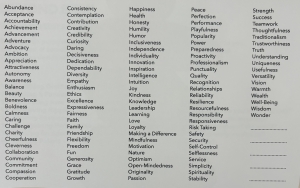
Next, sort similar values into five groups to create your five core values. For example, “family”, “community”, and “friendship” could be grouped into a core value of “relationships.” And “strength”, “peace”, and “resourcefulness” could be grouped into a core value of “resilience.”
For each of the five core values, write down why this value is important to you on a personal level, how you are already practicing it in your life, and what is one small thing you can do this week to help you live in this value more. Also, reflect on what you regularly do that feels misaligned with these core values.
“You want to write down what it looks like when you’re living your value because valuing community might look differently for you than it does for someone else,” says Dr. Friedlaender. “Also, our values can change slightly over time, so even if you’ve identified your values in the past, it can still be helpful to go through this reflection again.”
3. Strengths or Gifts
The third leg of the stool represents your strengths or gifts. These can be concrete skills, such as writing, playing the piano, or being technologically savvy, or more general gifts that make us unique and special, like the ability to inspire others or having high emotional intelligence.
To identify your core strengths or gifts, reflect on these questions:
- What activities make you feel capable and why?
- What do people come to you for? What are you known for?
- What kinds of problems do you enjoy and are skilled at solving?
- What do you notice in your surroundings that other people tend to miss?
- What is a strength you have consistently used to get to where you are now?
Examples of Strengths (skills you’d find on a resume):
- Writing, presenting, technological skills, teaching, etc.
Examples of Gifts (more general traits that are special to you):
- Having life experience and wisdom
- Having a good sense of humor
- Being a good listener and helping people feel seen and heard
- Being an effective and inspiring leader
- Having a high emotional and social intelligence
- Staying motivated and having perseverance
- Being resilient, equanimous, and optimistic during challenging times
- Having good judgement and discernment
- Being curious and open to new ideas or perspectives
- Having a high capacity for forgiveness, compassion, and empathy
… add more of your own
Write down your top five strengths and/or gifts. If you are struggling with this section, ask other people, “What would you say are my strengths and unique gifts? What would you come to me for help with?”
“When people feel a lack of purpose in their lives, it’s often when they aren’t living in alignment with one of the three legs of the stool,” says Dr. Friedlaender. “For example, when they aren’t engaging in activities that bring them joy, or not living in alignment with their values, or not offering their gifts to the world.”
The Seat of the Stool
The seat of the stool is the external component of purpose and represents needs in the world that are important to you. Ask yourself, “What really matters most to me, outside of myself? What needs in the world am I emotionally moved by?”
Make a list of world or societal needs that you care about, where you’re naturally inclined and motivated to act and make a difference. There are no issues too insignificant or too local. The more specific you can be about what really matters the more meaningful your contribution can be.
Here are some examples:
- Knowing my neighbors
- Child literacy
- Community gardens
- Public transportation access
- Climate change
- Homelessness and world hunger
- Health and wellness, healthcare
- Equity and justice in education
- Animal welfare
- Affordable housing
… add more of your own
Once you’ve identified the world needs you feel most passionate about, you can put the parts of the stool together, and ask yourself:
How can I engage in an activity that brings me joy, that is aligned with my values, and offers the opportunity to apply my strengths and gifts to make a difference with a need in the world that I care about?
If answering this question feels daunting, start by answering just one piece of the framework’s questions, whichever one calls you first. Perhaps it is the need in the world that calls to you, perhaps it is what brings you joy. From there, brainstorm the other parts of the stool. It can also be helpful (and more fun) to do this with a friend.
“All four pieces of the stool matter in the whole picture of living a meaningful, purposeful life,” says Dr. Friedlaender. “When we bring our full selves in service of making the world a better place, it gives us a profound sense of value in the world. At every age, our lives matter and we can make a difference, and living with purpose is really powerful for our health, happiness, and longevity.”


