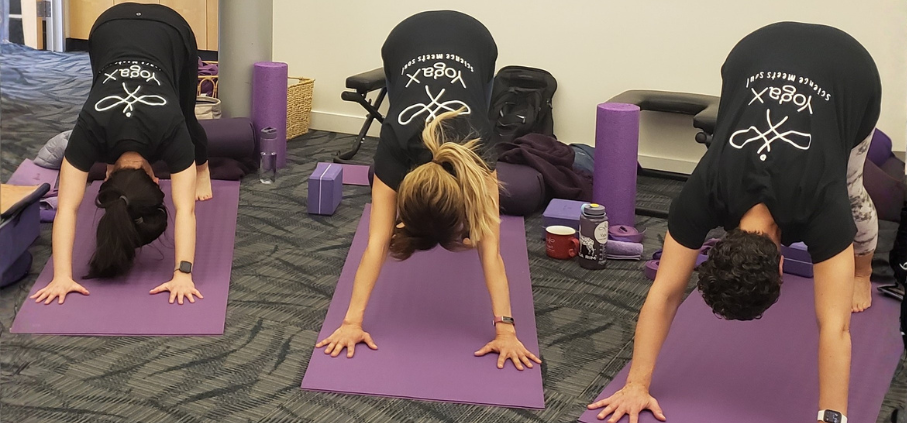
When most people think of yoga, they picture flexible bodies contorting into intricate poses at a local yoga studio. However, thanks to Dr. Laura Roberts who brought YogaX into her department, Stanford Psychiatry’s YogaX program is expanding that stereotype by offering yoga teacher and therapy trainings, all focusing on bringing therapeutic yoga into healthcare. YogaX trainings highlight not simply the physical postures of yoga, but serve as comprehensive lifestyle medicine practices grounded in ancient wisdom and modern science.
“We perceive yoga as a lifestyle choice,” says Christiane Brems, PhD, founder and director of YogaX within Stanford Medicine’s Department of Psychiatry and Behavioral Sciences.
“For us, yoga is not simply about the shapes and movements associated with Western postural yoga, but rather we embrace the entire eight-limbed approach to address the health of the whole person,” says Dr. Brems.
The Eight Limbs of Yoga
YogaX offers 1,000 hours of training for yoga teachers and healthcare professionals to become certified yoga teachers or therapists and offer therapeutic yoga practices in healthcare settings. All trainings are inspired by the eight limbs of yoga, an ancient comprehensive framework that addresses overall health and wellbeing.
The first limb, focused on ethics and values, serves as the foundation to ensure a practice of beneficence. The second limb, focused on discipline and purpose, ensures that practices have meaning and direction. The third limb relates to movement and physical health, and rather than teaching challenging yoga postures, YogaX focuses on functional movement that enhances strength, power, balance, mobility, and endurance. The fourth limb is focused on breathwork and helps regulate the nervous system to reduce stress, improve sleep, and promote emotional resilience and well-being.
The remaining limbs work with moving inward. The fifth limb invites careful management of sensory inputs to reduce overstimulation. The sixth limb cultivates concentration and focus, reducing distractibility. The seventh limb involves contemplation and meditation, fostering awareness, compassion, lovingkindness, and equanimity (non-reactivity). The eighth, and final limb refers to the joyful recognition of being part of a greater web of life that supports us and that, we in turn, are responsible to nourish.
“When we view yoga from this eight-limb perspective, we see that it is a holistic practice that addresses not only movement, but all other lifestyle medicine pillars, such as nutrition, social connection, gratitude and purpose, resilience, and cognitive enhancement,” says Dr. Brems.
“Yoga taught in this way addresses whole-person health, promotes the prevention of illness as well as disease management for those who already present with physical or mental health conditions,” says Dr. Brems.
YogaX’s Unique Approach
What sets YogaX apart from other yoga teacher training or yoga therapy programs is a commitment to five principles that guide all trainings and services:
- Holistic – Each training addresses every aspect of health, such as physical, mental, emotional, and relational well-being, deeply honoring each person’s biopsychosociocultural context.
- Integrated – Each training integrates the eight limbs along with evidence-based practices grounded in Western medicine, positive psychology, and interpersonal neurobiology.
- Accessible – Each practice includes adaptations and variations that support everyone regardless of physical ability, background, context, or need and that emphasize that everyone is welcome.
“Accessibility is very important for us—both regarding the use of yoga props to support all bodies and their bioindividuality as well as making all practices accessible on a mental and emotional level,” says Dr. Brems. “Due to stereotypes about yoga, such as ‘it’s only done at studios’ or ‘yoga is expensive’ or ‘yoga is for flexible people’, some think they can’t do it. We work hard to break down those barriers and present yoga in a way that serves everyone.”
- Intentional – Each session offers a clear purpose and invites students to set their own intention related to making their practice meaningful and healthful.
- Beneficence – YogaX offers a yoga that pledges to first do no harm and seeks to create health and wellbeing for all. Not surprisingly, YogaX offers many free services, including classes on YouTube, blog articles, and live online classes three times per week.
“Many healthcare providers taking our trainings, who had previously felt burned out have said that ‘This training saved me; it restored my sense of purpose and reminded me of why I went into healthcare to begin with’,” says Dr. Brems. “That sentiment is so beautiful because that’s the heart of the yoga practice. Our trainees are not only learning the content, but are experiencing the benefits themselves, which makes them even more effective in sharing the practices with their patients.”
YogaX Trainings
If you are a yoga teacher looking to work in healthcare settings, or if you are a healthcare provider seeking to incorporate therapeutic yoga practices into your clinical work, YogaX has a training to meet your needs, with scheduling designed for those who work full-time.
Following are YogaX’s training offerings (click on the links below for more information):
- 200-hour Yoga Teacher Training with Healthcare Setting Emphasis
- 300-hour Therapeutic Yoga Teacher Training: Advanced Applications of Yoga in Healthcare and Allied Healthcare Settings
- 300-hour Integrated Holistic Yoga Therapeutics in Healthcare (for healthcare providers)
- 800-hour Integrated Holistic Yoga Therapy Program
- Mental Health Certificate
- Trauma-Informed Yoga Certificate
- Integrated Holistic Health Coaching Certificate
“Many yoga teachers and healthcare providers are seeking community and opportunities for collaboration, and this is what YogaX provides,” says Dr. Brems. “Many of our trainees say that they have found their people, or found their home with YogaX. This is important because they are on the forefront of bringing yoga into Western medicine and their work is just the beginning.”


