
Take an ‘Awe Walk’: The Benefits of Walking with Presence
As we age, particularly after 75, negative emotions like sadness, anxiety, and loneliness tend to increase while positive emotions decline . This matters more than we might think. Sustained negative emotions are linked to social isolation, depression, cognitive decline, heart disease, and even early mortality.
The good news? Simple practices—such as taking daily “awe walks”—can counteract this. Activities like keeping a gratitude journal or doing acts of kindness have also been shown to meaningfully boost positive feelings and overall wellbeing. These benefits aren’t instant, but with regular practice they build gradually over time.
Why Awe and Gratitude Are Special
Gratitude and awe are what researchers call self-transcendent emotions. Unlike most positive emotions that focus our attention inward, these two turn our attention outward. Awe in particular:
- Connects us to something larger than ourselves
- Increases generosity and willingness to volunteer
- Creates a “small sense of self” that helps us gain perspective
- Fosters humility and appreciation for others
- Encourages curiosity and creativity
Awe is the feeling we get in the presence of something vast that challenges our view of the world—and it doesn’t have to be dramatic. It can come from something enormous like a starry night sky, or something tiny like the intricate pattern on a butterfly’s wing. Awe-inspiring experiences are often described as ineffable or beyond words.
Research has also identified two powerful, but often overlooked sources of awe:
- moral beauty—witnessing acts of human courage or kindness (like a stranger rushing into a burning building)
- collective effervescence—the energy of people moving together (like a crowd dancing at a concert)
What the Research Shows
A landmark study out of UC San Francisco, lead by Virginia Sturm, PhD, found that older adults who took a weekly “awe walk” for just eight weeks reported significantly more positive emotions and less daily distress. Participants who walked regularly but without an awe focus did not experience the same benefits—even though they actually walked more frequently, possibly because they thought the study was about exercise.
The emotional gains in the awe group were notable: participants showed increased compassion and gratitude in their day-to-day lives over the course of the study, measured through daily surveys tracking their emotional state.
“I find it remarkable that the simplest intervention in the world – just a three-minute conversation at the beginning of the study suggesting that participants practice feeling awe on their weekly walks – was able to drive significant shifts in their daily emotional experience. This suggests promoting the experience of awe could be an extremely low-cost tool for improving the emotional health of older adults through a simple shift in mindset,” says Dr. Sturm.
The amazing thing about gratitude and awe are that they are orientations that we can cultivate and when practiced regularly they will arise more and more naturally. And taking a daily “Awe Walk” is a great place to start.
How to Take an “Awe Walk”
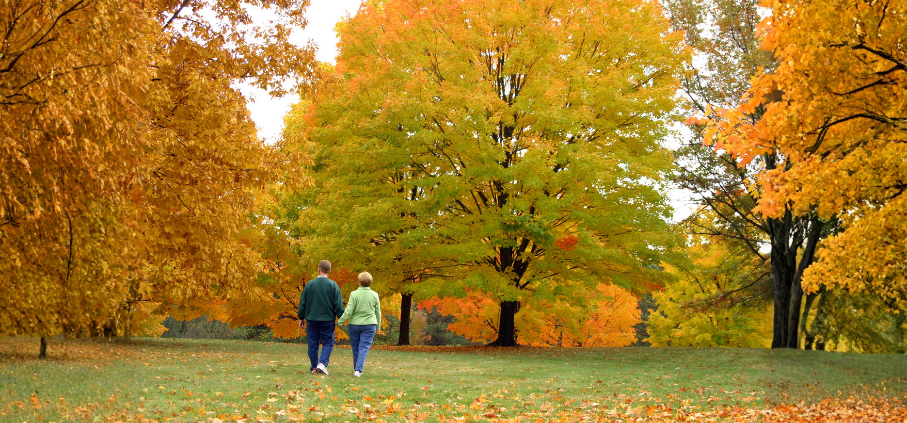
You don’t need special equipment or a lot of time. On your next walk, try shifting your mindset—look at the world with fresh eyes. Notice the structure of a leaf, the way light changes across a building, an unexpected act of kindness among neighbors, or simply the fact that you’re alive and moving through the world. It can be particularly powerful to draw on senses beyond sight, which we rely so heavily on. Tune into your other senses, notice the loud and subtle sounds around you, feel the air or sunshine on your skim, touch tree bark or flower petals, and notice the smells in the air and how they shift throughout the seasons. These small shifts in attention is all it takes to begin—and research shows that taking a daily “awe walk” can change your life!
Here is a poem by Buddhist leader, Thich Nhat Hanh, who taught walking meditation as a practice for presence and wellbeing:
Walking Meditation
Take my hand.
We will walk.
We will only walk.
We will enjoy our walk
without thinking of arriving anywhere.
Walk peacefully.
Walk happily.
Our walk is a peace walk.
Our walk is a happiness walk.
Then we learn
that there is no peace walk;
that peace is the walk;
that there is no happiness walk;
that happiness is the walk.
We walk for ourselves.
We walk for everyone
always hand in hand.
Walk and touch peace every moment.
Walk and touch happiness every moment.
Each step brings a fresh breeze.
Each step makes a flower bloom under our feet.
Kiss the Earth with your feet.
Print on Earth your love and happiness.
Earth will be safe
when we feel in us enough safety.
