
By Sophia Fay, BS and Sharon Brock, MS, MEd
We may think that play is only for kids, but according to the National Institute for Play, it is a biological need across the entire lifespan. Additionally, play is not an activity, but rather a “state of being.” Some key characteristics of being in a play state are engaging in an activity to the point of losing track of time, freely choosing the activity, and enjoying it for its own sake. Research shows that play is beneficial for people of all ages—it reshapes how the prefrontal cortex processes information, lowers stress hormone levels, and builds cognitive flexibility that protects against age-related decline.
Regarding longevity, we know that both exercise and social connection extend life. Since research also shows that play is good for the brain, why not combine all three?
“The biggest challenge isn’t knowing what’s good for you—it’s getting people to actually do it,” says Anne Friedlander, PhD, exercise physiologist and Associate Director of Stanford Lifestyle Medicine.
“If an activity is fun and you do it with friends, you’re more likely to stick with it. That’s reason enough to combine the three things, independent of whether there’s a biological mechanism linking them,” says Dr. Friedlander.
Stacking the Longevity Factors
According to Dr. Friedlander, exercise, social engagement, and play each increase longevity, but combining the three could potentially offer compounding benefits.
Regarding exercise, there is abundant data that illustrates its connection to longevity. For example, research shows that when we contract our muscles, molecules called myokines are released into the bloodstream that improve cognition and metabolism, and reduce inflammation. “During exercise, your muscles act like pharmacies,” says Dr. Friedlander, “sending out beneficial substances to the rest of the body.”
Research also shows that combining exercise with social connection has a potential effect on lifespan. One study followed 8,577 adults for 25 years and found a striking pattern: the sports associated with the greatest longevity gains were those that involved social interaction. Tennis was associated with 9.7 additional years of life expectancy, badminton with 6.2, and soccer with 4.7, compared to just 1.5 years for solo gym workouts.
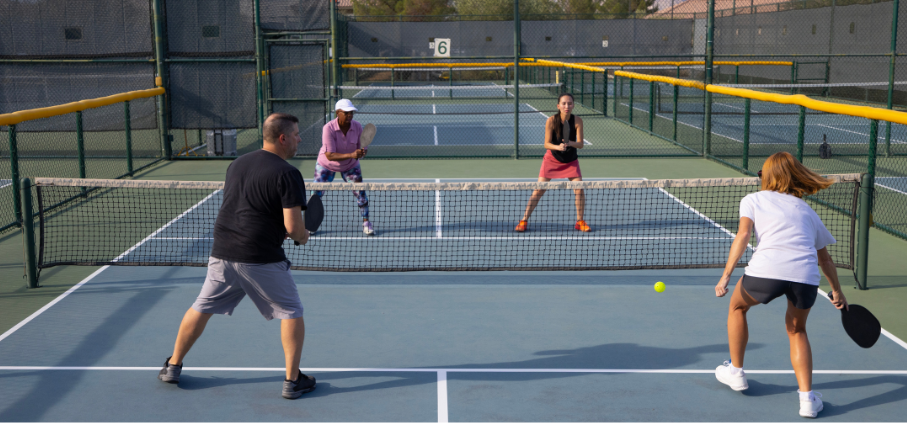
Each factor—exercise, social connection, and play—has independent research to back up its positive effect on longevity and there are opportunities to pursue them simultaneously. A game of pickleball is an example of combining these three factors since it’s exercise, it’s social, and it’s playful. “The more you can integrate all three, the better off you’re going to be,” says Dr. Friedlander.
The variety of exercise we do also matters. One study followed 111,000+ adults over 30 years and found that having variety in exercise was linked to a 19 percent lower risk of premature death, independent of total activity levels.
Part of the reason may be that different types of exercise load different biological systems, each triggering its own cascade of benefits. For example, endurance exercises place the greatest demand on the cardiovascular system, resistance training loads the muscles, and learning choreography in a dance class benefits brain health.
“Since different types of exercise load different systems, our body likes variety and cross-training rather than just doing one thing over and over again,” says Dr. Friedlander. “We can intentionally add play and social connection activities to our exercise routines to ensure that we get the variety our body needs.”
The Best Exercise for Longevity
So, which specific activities should we choose for longevity? Unfortunately, there is no clear answer. Most research on which exercises are “the best” come from observational studies that track what people already do, rather than randomized trials that could more clearly isolate cause and effect.
Also, there are hundreds of variables that factor into our longevity. People who play tennis may live longer than solo gym-goers due to many reasons other than their exercise choices. “One has to be careful when comparing different types of exercise because there are so many aspects to consider,” says Dr. Friedlander. “These studies don’t test all types of exercise or include all populations. There are so many factors involved and it’s very hard to isolate all the variables.”
Dr. Friedlander is equally cautious about steering people toward any single activity. What keeps one person engaged for decades may bore another in three weeks. She also points to evidence that mindset shapes the biological effects of exercise. Exercise that feels stressful or coerced may not produce the same benefits as exercise that feels like a choice.
Even though there is no single study that proves that playful exercise is a distinct formula for longevity, data shows that movement that is social, varied, enjoyable, and consistent is associated with the best outcomes.
So, try different things—walking clubs, biking clubs, weekend hiking groups, masters swim teams, or recreational leagues—to figure out what movement feels most playful for you. The format of the exercise matters less than the qualities that make you want to come back, such as the natural beauty of a good hike, the endorphin rush after a good swim, or the friendships you make in a walking club.
“It’s not like everyone who wants to live longer should go out and take up tennis,” says Dr. Friedlander. “Find the activity that’s going to be the one for you. The best exercise for you is the one you want to do.”


