Posts

By Sharon Brock, MEd, MS

Don’t Hit Snooze! And Other Practical Tips for Optimal Sleep

Millions of Americans share a similar experience every morning. The alarm goes off, but they’ve already been awake for hours in bed. They hit the snooze button to squeeze in a few more minutes of precious rest, not realizing they were making their sleep problems worse.

“Hitting the snooze button is one of the worst things you can do because it prolongs morning grogginess and associates the bed with being awake,” says Fiona Barwick, PhD, DBSM, Stanford Clinical Associate Professor, Psychiatry and Behavioral Sciences – Sleep Medicine. “Rather than hitting snooze, it’s important to get out of bed within 15 minutes of the alarm going off and get some natural light to stop melatonin production.”

You may not think that something you do first thing in the morning will affect your sleep that night; however, Dr. Barwick says that the behaviors we engage with throughout the day can impact the quality of our sleep at night.

“Getting a good night’s sleep is a 24-hour endeavor,” says Dr. Barwick.

How Does Sleep Work?

According to Dr. Barwick, we fall asleep when these three biological systems are in working order:

  • Circadian Rhythm (CR)
  • Sleep Drive (SD)
  • Stress Management (SM)


Here is a list of behaviors that can negatively affect the three systems (CR, SD, SM), as well as alternative behaviors that have a more positive impact:

Since it may be difficult to change all the behaviors in this table, Dr. Barwick shares the top two behaviors that are most important for each system:

  • Circadian Rhythm
  1. Sleeping in the right window for your body clock (e.g., 10pm – 6am, 11pm – 7am, or 12am – 8am, etc.) and staying consistent with those sleep and wake times.
  2. Appropriate exposure to light and darkness to sync the release of melatonin with wake and sleep times (e.g., getting morning sunlight, not looking at screens one hour before bed, and making sure the bedroom is dark).
  • Sleep Drive
  1. Increase sleep drive by tiring the body with regular physical exercise and outdoor light exposure.
  2. Getting out of bed promptly (no hitting the snooze button) and making sure you spend the appropriate amount of time in bed (anywhere from 6-10 hours depending on your individual genetics and age).
  • Stress Management
  1. Physical relaxation—Deep breathing throughout the day to relax the body.
  2. Mental/Emotional relaxation—mindfulness meditation or journaling to process emotions before going to bed.

Practice of the Month:

Avoid hitting snooze (i.e., get out of bed when the alarm goes off) and create morning, midday, and evening routines to optimize the three key systems for sleep.

From the table above, write two behaviors you can do in the morning, midday, and at night. Make sure that you’re addressing all three systems (CR, SD, and SM).

What to do in the morning for good sleep:

1)

2)

What to do during the day for good sleep:

1)

2)

What to do at night for good sleep:

1)

2)

Here is a sample:

What to do in the morning for good sleep:

1)  Put phone out of arm’s reach and get out of bed right after alarm goes off (CR, SD).

2)  Go for a walk around the block, then eat breakfast (CR, SD).

What to do during the day for good sleep:

1)  Stress reduction: do a 10-minute mindfulness meditation at lunch (SM).

2) Physical exercise: do a 45-minute workout right after work (SD, SM).

What to do at night for good sleep:

1) Turn off all screens one hour before bed and write in my journal while listening to relaxing music (CR, SM).

2) Take a luxurious candle-lit bubble bath while taking deep breaths and counting my blessings (CR, SM).

“These are behaviors we can do to increase the likelihood of getting better sleep, but there may be times when we do everything right and still not sleep well,” says Dr. Barwick. “The most important thing to remember is that we will be fine the next day. We are evolutionarily adapted to deal with insufficient sleep, and we can still do what we need to get done, even without the full amount of sleep that we normally get.”


By Nicole Molumphy

How to Get More Benefits from 10,000 Steps per Day

Many of you are familiar with the 10,000-steps-a-day walking trend, but you may not know where it originated. The idea of walking 10,000 steps per day did not come from scientific research; rather, it came from a marketing campaign for a pedometer ahead of the 1964 Tokyo Olympics. Since the Japanese symbol for 10,000 looks somewhat similar to a person walking (see image below), the pedometer was named Manpo-kei or 10,000 steps meter, and the 10,000-step-a-day walking trend was born.


We know walking is good for us, but what do researchers have to say about this 10,000 number? Is this the right number of steps? What are the health benefits of reaching this number?

A 2023 research study showed 8,000 to be the sufficient number of steps to yield significant health benefits. In this study, participants who took 8,000 steps or more on one or two days during the week showed substantially lower cardiovascular and all-cause mortality risk.

Stanford Lifestyle Medicine Movement and Exercise pillar member Corey Rovzar, PhD, DPT, puts the 8 and 10 thousand numbers into perspective. “What is more important than hitting an exact number is that you’re moving more throughout the day,” says Dr. Rovzar. “If looking at a pedometer and trying to hit 8,000 steps will help you move more, then it’s a great tool, but rather than fixating on an exact step count, I recommend you think about your day and envision opportunities to move.”

Rather than walking all 8,000 steps in one go, which would take about 80 minutes at three miles per hour, Dr. Rovzar recommends walking the 8,000 steps throughout the day, such as in the morning and evening and after each meal. For example, you could split the 8,000 steps (80 minutes of walking) into four, 20-minute walks. If you stick to the 10,000-step goal (100 minutes of walking), that breaks down to five, 20-minute walks. This recommendation is good news for those who sit at a desk since taking several short walks during the workday is a perfect way to take a break. “It is important to note that all steps count! Even a few steps to the bathroom or to another room contributes to this overall count,” says Dr. Rovzar.

Ideas on How to Meet Your 10,000 Steps Goal:

  • Take the stairs instead of the elevator.
  • Walk more during errands by parking your car farther away from your destination or getting off the bus or train a stop early.
  • Walk more during your work day by taking a “walking meeting” or walking while on the phone.
  • Walking after each meal can help with digestion, blood sugar management, and cardiovascular health.
  • Walk every morning, evening, and during your lunch break. Even 10 to 15 minutes of walking can add up to 1,000 steps.
  • Catch up with a friend by going on a walk instead of meeting for coffee.
  • Use a step tracker to help you stay motivated and track your progress.

How to Get More Out of Your 10,000 Steps

If you’re already walking 8 to 10 thousand steps daily, you may be ready to take your walking to the next level. If so, Dr. Rovzar recommends adding modifiers to your walking routine to help you meet additional fitness goals, such as improving balance or building muscle.

Here are a few of Dr. Rovzar’s recommendations for intensifying your daily stroll and gaining more health benefits:

1) Cardiovascular (Endurance) Modifier:

Interval walking

Interval walking involves alternating fast and slow walking cycles. Researchers recommend five intervals of fast and slow phases, each lasting roughly three minutes. The effort expended should be 40 percent of your maximum effort for the slow phase and 70 percent for the fast phase.

2) Muscular Strength Modifiers:

Walk up and down hills or stairs multiple times

If you are looking for strength benefits, hills may become your new best friend. Walking hills or stairs not only has excellent aerobic benefits but also serves as a great form of strength training.

Add ankle and wrist weights or wear a weighted backpack

Another strength training modification is adding weight to your walk, either with ankle or wrist weights or by rucking. The term rucking originated during boot camp training and involves using weighted vests or backpacks while hiking or walking.

3) Balance Modifiers:

Take side steps

March (i.e., lift your knees as you walk)

Walk backwards

It is essential to perform balancing exercises as we age. Implementing side steps, marching, or walking backward are great ways to train your body to handle non-forward-facing movements, enhance joint mobility, and improve flexibility. Balance training is also an effective way to strengthen different muscle groups. For example, side steps engage your abductors, which are hip muscles involved in getting out of your car and transitioning out of bed in the morning.

4) Cognition Modifier:

Dual-task training

Cognition may also be enhanced with walking practices, like dual-task training. This practice involves performing a mental task while walking, such as talking to someone while walking, keeping step time to a metronome, or counting backward from 100. Combining the mental task with the physical action of walking forces the walker to increase concentration, which sharpens the mind and improves balance and stability.

Whole Body Health Benefits

In addition to the physical benefits walking offers, Dr. Rovzar says that walking improves mental clarity and well-being. Taking a step away from work and going on an outdoor walk can help you overcome mental roadblocks. Studies have found mental health benefits from walking outside in nature, including decreased cortisol levels, diastolic and systolic blood pressure, and pulse rate. While using a treadmill may be a great way to multitask and get in extra movement, there are considerable mental health benefits from taking a break outside, getting fresh air, and stopping to smell roses and pet dogs on your walk.

“We often strive to maximize our time working, but in reality, you might not be saving yourself time by omitting the breaks,” says Dr. Rovzar. “I recommend getting out of your work environment and going for an outdoor walk every couple of hours during the workday, even if it’s just five-minutes of movement to get your blood flowing.”

Practice of the Month:

Walk 5 Days per Week for 30 minutes with a Modifier

The US guideline for moderate physical activity is 150 minutes per week (which breaks down to five 30-minute brisk walks with a modifier per week). To ensure you’re improving muscle strength, balance, endurance, and cognition every week, Dr. Rovzar recommends assigning different modifiers to different days.

Sample Walking Routine (30 minutes per walk):

Monday: Walking up and down hills on Mondays (endurance)

Tuesday: Rucking (strength)

Wednesday: Incorporating intervals of side-stepping, marching, and walking backward (balance)

Thursday: Interval walking (endurance)

Friday: Adding ankle and wrist weights (strength) while counting backward from 100 with each step (cognition)


If a 30-minute walk seems too daunting, Dr. Rovzar suggests starting with 10 minutes of walking and incrementally working your way up to 30 minutes daily. “Much of this comes down to goal setting,” she says. “If you set too lofty of a goal, it becomes unachievable, but if you break your goal down to an amount that seems feasible and perhaps try it just for a week, it becomes more likely you will remain consistent in attaining it.”

By Sharon Brock, MEd, MS

Recommended Exercises for Adults 50+

Key Takeaways:

Adults 50+ should choose exercises that promote these three aspects of fitness: strength, endurance, and balance.

Stanford researchers analyzed the benefits and risks of the following exercises:

  • Pilates
  • Martial Arts (e.g., Tai Chi, Karate, Taekwondo)
  • Walking
  • Running
  • Masters Athletics (i.e., team sports for adults)
  • Resistance Training (e.g., exercise machines, free weights, elastic bands)
  • High-intensity Interval Training (HIIT)

It is well known that exercise is crucial for overall health; however, as we age, it’s essential to know which exercises are best to increase longevity and quality of life. For older adults (defined as 50 and above), the three main goals regarding physical activity are to build muscular strength, improve cardiorespiratory endurance, and increase flexibility and balance to reduce the risk of falling. Stanford researchers reviewed studies on several types of exercises to assess which were most suitable and effective for older adults to achieve these goals.

“It’s important to maintain a consistent exercise regimen in midlife and beyond,” says Matt Kaufman, MD, Stanford Physical Medicine and Rehabilitation resident and one of the authors of the review. “Many factors contribute to decreased activity as we age, whether it be pain, time constraints, complacency stating they haven’t done exercise recently. Sometimes, there is a fear of getting hurt or embarrassment when starting a new exercise routine, which can also be a major barrier for older adults to start exercising. With the various exercises we cover in this review, we hope readers will be inspired to choose one they enjoy and start moving.”

With so many types of exercises to choose from, it can be overwhelming to know where to begin. Reviewers assessed whether activities required equipment, were high or low impact, and if they were practiced in a social setting. The purpose of the review was to define the benefits, risks, and recommendations for these exercises that are popular among older adults: Pilates, martial arts, walking/jogging, running, Masters Athletics, resistance training, and high-intensity interval training (HIIT).

Low-Intensity Exercises for Adults 50+

Pilates

Given the social nature of group classes, Pilates has become a popular exercise for older adults. Joseph Pilates created the exercise in the 1920s, and it has been shown to improve dynamic balance, hip and lower black flexibility, lower extremity muscle strength, and cardiovascular fitness. Caution is advised for those with osteoporosis, osteopenia, or discogenic pain and those with Parkinson’s disease, baseline postural instability, or dysautonomia.

Recommendation: 40- to 50-minute mat or apparatus Pilates sessions, three to four times per week.

Martial Arts

Martial arts include a variety of mind-body exercises that improve flexibility, mobility, endurance, and balance.

Tai Chi

Tai Chi, which involves breathing exercises accompanied by slow body movements, has been shown to improve cardiorespiratory fitness, increase muscle strength and balance, and decrease frequency and fear of failing.

Recommendation: 45- to 60-minute Yang-style Tai Chi sessions, several days per week, over a minimum eight-week duration.

Traditional Japanese Karate

Traditional Japanese Karate, a mind-body exercise focusing on mindfulness and effective use of bare hands for combat or self-defense, showed improvements in walking speed, motor reaction time, strength, and balance.

Recommendation: 60-minute sessions, twice per week, for more than 10 months.

Hard Martial Arts

Hard martial arts, such as Taekwondo, involve contact of the body against another person. Along with the benefits seen in other martial arts (increased strength, endurance, mobility, flexibility, and balance), hard martial arts have been shown to decrease cognitive decline.

Recommendation: 60-minute sessions, twice per week, for more than 10 months.

Walking

For many, the most accessible exercise is walking outdoors, which offers benefits in balance, muscular strength and endurance, and cardiorespiratory fitness.

Recommendation: 30- to 60-minute brisk walking sessions several times per week.

High-Intensity Exercises for Adults 50+

Running

Like walking, running is easily accessible and improves balance, muscular strength and endurance, and cardiorespiratory fitness. However, because running has a higher impact than walking, it poses a greater risk of injury to the bones and joints of the lower body.

Recommendation: 30- to 60-minute running sessions several times per week.

Masters Athletics

Joining a team sport as an adult can have many benefits, such as improved balance, muscle strength and endurance, and cardiorespiratory fitness. Since this modality is a team sport, it also offers the opportunity for social engagement, which typically leads to greater adherence. The downside is that Masters Athletics are not as accessible as most exercises because they may be difficult to find or costly.

Recommendation: Join a local team for a sport you enjoy!

Resistance Training (i.e., exercise machines, free weights, elastic bands)

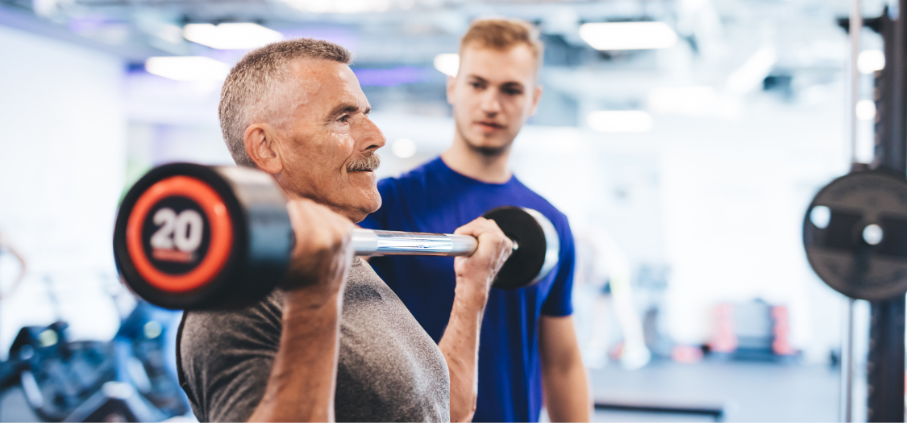
Extensive data suggest resistance training is the most effective exercise to improve skeletal muscle mass, strength, and physical function. Additional benefits of resistance training in older adults include gait speed, balance, cardiovascular fitness, and decreased fall risk.

Recommendation: 1-hour session twice per week. Consultation with a trainer may be appropriate to avoid injury.

High-Intensity Interval Training (HIIT)

HIIT, characterized by brief intermittent bouts of high-intensity aerobic exercise (such as sprinting during a walk or bike ride, or taking a HIIT group fitness class), has shown increased muscle building, power, and cardiorespiratory fitness. HIIT is a time-efficient exercise that considerably increases aerobic capacity despite its low time commitment. Since HIIT requires near-maximal effort in short bursts, it is recommended that HIIT be supervised to prevent injury.

Recommendation: 20- to 30-minute sessions twice per week. Each session should include six one-minute high-intensity bursts of effort.

“I often recommend some form of resistance training for my patients, whether in a gym or at home. These exercises can help build muscle and prevent falls,” says Dr. Kaufman. “I also recommend Masters Athletics since they have the added benefit of a sense of community that makes exercise more enjoyable and helps keep you accountable.”

Conclusion

Reviewers found similarities in fitness benefits depending on whether the exercise was low- or high-intensity. Lower-intensity exercises (Pilates, martial arts, and walking) significantly increased flexibility, balance, and endurance. Whereas, higher-intensity exercises (running, Masters Athletics, resistance training, and HIIT) showed greater improvements in cardiorespiratory fitness, muscle building, and strength.

“When creating an exercise regimen, I recommend engaging in both low- and high-intensity exercises every week. This could look like taking an hour walk every morning along with hiring a trainer at the gym for weekly weightlifting sessions, or taking a Pilates class every week along with your regular HIIT classes,” says Dr. Kaufman. “Ultimately, the best exercise regimen is something you will stick with. Whether it is one form or multiple forms of exercise, what is most important is that you are consistently active!”