


By Nicole Molumphy, BS and Sharon Brock, MEd, MS

Do you ever get those late-night cravings or feel like your hunger is never satiated? Research shows that consistent short sleep duration (less than 7 hours per night) can influence metabolic health, affect the function of appetite hormones, increase food cravings, and lead to a 38 percent increase in obesity in adults.
Consistent sleep deprivation can lead to altered functioning of the appetite hormones ghrelin and leptin. Ghrelin increases our appetite and is released by cells in the stomach lining. When your stomach is “growling,” that is the ghrelin hormone talking. Conversely, the hormone leptin, made by our fat cells, lowers our appetite. Studies have revealed that sleep deprivation can lead to increased ghrelin and decreased leptin, resulting in an overall experience of constantly being hungry.
“There are so many health conditions associated with poor sleep,” says Rob Oh, MD, Clinical Associate Professor (Affiliated) and family physician at the Veterans Affairs Health Care System in Palo Alto. “With chronic sleep deprivation, your metabolism becomes dysregulated, leading to cravings for processed foods. Also, you’re less likely to exercise, you feel more stressed, and you’re more likely to think poorly. The combination of these factors can lead to metabolic health problems like obesity and type 2 diabetes.”
Our cortisol levels are typically lowest near midnight and then increase towards waking hours, ultimately peaking around 9 a.m. Studies demonstrate that reoccurring poor sleep is associated with an altered cortisol secretion pattern.
For example, delaying your bedtime could lead to high cortisol levels in the middle of the day, rather than just in the morning. Sustained high levels of cortisol can lead to an increased amount of insulin in the blood, which promotes the accumulation of belly fat and has the potential to lead to prediabetes, type 2 diabetes, and other metabolic disorders. An increase in cortisol levels during the day may induce prolonged feelings of stress, increased food cravings, and further insomnia—promoting a recurrent, cyclical pattern.
“Inadequate sleep disrupts hormone levels, which dysregulates one’s metabolism and makes individuals hungrier,” says Dr. Oh. ” When we are hungrier, we eat more, which leads to weight gain and potentially metabolic disease.”
If that’s not bad enough, cravings for ultra-processed foods, sugars, and alcohol become more of a tease with sleep deprivation. A possible mechanism for this added hunger is an increased activation of the endocannabinoid system, which is found throughout the body and controls several biological systems, including sleep, mood, and appetite.
Research shows that a lack of sleep may also result in insulin resistance, a driving factor in prediabetes and type 2 diabetes. Insulin is a hormone made by the pancreas that regulates blood glucose levels. Insulin resistance occurs when cells in the liver, fat, and muscles do not respond well to insulin, and in turn, glucose is not taken up into the blood.
The exact mechanism behind the causal relationship between insufficient sleep and insulin resistance is still being studied, however, some studies note that increased inflammatory markers, like C-reactive protein and hormone dysregulation, such as cortisol may be involved.
Currently, prediabetes affects one in three adults in the US. While many mechanisms contribute to the development of prediabetes and type 2 diabetes, some of the more prominent ones include impaired cellular insulin sensitivity, modified gut microbiota, and overly-sensitive sympathetic nervous system (fight-or-flight) activation. When the sympathetic nervous system is activated, it signals the liver to release more glucose into the bloodstream, leading to higher blood sugar levels.
Unfortunately, research finds that “weekend recovery sleep” is not enough to bring your metabolism back into balance after a lack of sufficient sleep throughout the week. Instead, Dr. Oh recommends taking a holistic approach and examining not only your sleep habits but also your nutritional choices and workout routines to support the restoration of metabolic health.
For those with pre-diabetes and type 2 diabetes, a diet focused on whole foods and low refined carbohydrates is critical for weight loss and glucose control.
Specifically, Dr. Oh recommends a low carbohydrate diet, such as consuming 75 to 100 grams of carbohydrates per day, to control and balance blood sugar levels. He also recommends quick, 20-minute, high intensity workouts for time-efficient and effective exercises that promote metabolic health. Regarding supplements, Dr. Oh recommends magnesium to promote muscle recovery and relaxation before bedtime.
“Optimal sleep is so intertwined with athletic and exercise performance, brain health, and metabolic health,” says Dr. Oh. “Sleep really is a keystone area where many of us can do better and hence reducing our risk for metabolic diseases and lengthening our healthspan.”

By Angel Cleare, BS and Sharon Brock, MS

From Oura Rings to Fitbits, wearable sleep-tracking devices are all the rage in today’s technology-driven world. In 2020, almost 30 percent of US adults used wearable healthcare devices. But rather than running out to buy one, we must first ask ourselves, “Do these wearables live up to the hype?” We sat down with a Stanford sleep expert to find out.
“Sleep wearables can be helpful tools to provide insights on your sleep trends over weeks to months. However, if you find that the wearable causes you anxiety when you view the sleep data or becomes an obsession to perfect the daily sleep stats, it may be no longer a helpful tool for your sleep health,” says Cheri Mah, MD, MS, sleep physician and Adjunct Lecturer at the Stanford Sleep Medicine Center.
As Dr. Mah alluded, the quest for perfect sleep data on one’s wearable can ironically lead to restless nights. This preoccupation with perfecting one’s sleep is a condition known as orthosomnia. Instead of winding down in preparation for sleep, people with orthosomnia may feel anxious about achieving the “perfect” sleep data the following morning—an anxiety that can keep them up at night.
“If you find viewing the daily sleep wearable data is causing you unhealthy stress or anxiety, it may be time to consider making a change. Consider switching to only viewing the wearable data on a weekly basis to note weekly trends, take a break from using the wearable, or if you still want to track your sleep patterns, switch to using a pen and paper sleep journal,” says Dr. Mah.
It’s also important to note that the data sleep wearables provide is not always accurate, so we may be feeling anxiety over inaccurate data. Dr. Mah says that although wearables provide reliable estimates of sleep duration, bedtime and wake time, and sleep schedules, research shows there are limitations with accuracy and reliability regarding data on specific sleep stages, such as amount of REM and deep sleep.
Dr. Mah works with professional athletes, sports teams, and other high performing professionals. She has found sleep wearables to be helpful to better understand their sleep patterns, make changes to improve their sleep habits, and ultimately improve athletic performance and health.
“For athletes and other high performers, wearables can be useful tools for establishing how their current sleep trends are, monitoring and optimizing sleep throughout their season, and ultimately, impacting on-field performance,” says Dr. Mah.
Conversely, Dr. Mah says those who struggle with sleep should be cautious of using a wearable and wearables are not intended to diagnose sleep disorders. Many wearables include motion-based sensors and therefore the sleep data can be misleading if someone has difficulty falling asleep or staying asleep. This can impact the wearable’s estimate for amount of time to fall asleep, awakenings at night, and the total sleep duration.
If you struggle with sleep, have insomnia, or have concerns about a clinical sleep disorder such as sleep apnea, Dr. Mah recommends reaching out to a primary care physician or a sleep physician.
“As technology continues to improve, the accuracy and reliability of sleep wearables will hopefully continue to get better. I anticipate that sleep wearables will become even more helpful for clinicians because they provide a longer snapshot of one’s sleep patterns than we wouldn’t otherwise have access to,” says Dr. Mah.
For those who want to track their sleep in another way, Dr. Mah recommends using a pen and paper sleep journal rather than a wearable. “You don’t have to use a wearable to gain insights about your sleep. A pen and paper sleep journal can be incredibly helpful, too,” she says.


Millions of Americans share a similar experience every morning. The alarm goes off, but they’ve already been awake for hours in bed. They hit the snooze button to squeeze in a few more minutes of precious rest, not realizing they were making their sleep problems worse.
“Hitting the snooze button is one of the worst things you can do because it prolongs morning grogginess and associates the bed with being awake,” says Fiona Barwick, PhD, DBSM, Stanford Clinical Associate Professor, Psychiatry and Behavioral Sciences – Sleep Medicine. “Rather than hitting snooze, it’s important to get out of bed within 15 minutes of the alarm going off and get some natural light to stop melatonin production.”
You may not think that something you do first thing in the morning will affect your sleep that night; however, Dr. Barwick says that the behaviors we engage with throughout the day can impact the quality of our sleep at night.
“Getting a good night’s sleep is a 24-hour endeavor,” says Dr. Barwick.
According to Dr. Barwick, we fall asleep when these three biological systems are in working order:

Here is a list of behaviors that can negatively affect the three systems (CR, SD, SM), as well as alternative behaviors that have a more positive impact:

Since it may be difficult to change all the behaviors in this table, Dr. Barwick shares the top two behaviors that are most important for each system:
Avoid hitting snooze (i.e., get out of bed when the alarm goes off) and create morning, midday, and evening routines to optimize the three key systems for sleep.
From the table above, write two behaviors you can do in the morning, midday, and at night. Make sure that you’re addressing all three systems (CR, SD, and SM).
What to do in the morning for good sleep:
1)
2)
What to do during the day for good sleep:
1)
2)
What to do at night for good sleep:
1)
2)
What to do in the morning for good sleep:
1) Put phone out of arm’s reach and get out of bed right after alarm goes off (CR, SD).
2) Go for a walk around the block, then eat breakfast (CR, SD).
What to do during the day for good sleep:
1) Stress reduction: do a 10-minute mindfulness meditation at lunch (SM).
2) Physical exercise: do a 45-minute workout right after work (SD, SM).
What to do at night for good sleep:
1) Turn off all screens one hour before bed and write in my journal while listening to relaxing music (CR, SM).
2) Take a luxurious candle-lit bubble bath while taking deep breaths and counting my blessings (CR, SM).
“These are behaviors we can do to increase the likelihood of getting better sleep, but there may be times when we do everything right and still not sleep well,” says Dr. Barwick. “The most important thing to remember is that we will be fine the next day. We are evolutionarily adapted to deal with insufficient sleep, and we can still do what we need to get done, even without the full amount of sleep that we normally get.”


Like a Renaissance explorer, the insatiable curiosity of Jamie Zeitzer, PhD, drives him to explore big questions as a senior researcher and co-director of the Stanford Center for Sleep and Circadian Sciences. After 25 years of conducting sleep research, including groundbreaking studies on circadian rhythms and how light affects the brain, Dr. Zeitzer still enjoys navigating the uncertain waters of research and helping us all get a better night’s sleep.
“What drives me in research is the fact that I don’t like uncertainty and I don’t like being wrong, and I picked a profession where I’m literally wrong all the time,” says Dr. Zeitzer, Professor (Research) of Psychiatry and Behavioral Sciences.
“Usually, the most obvious path in research is based on incomplete information, and it ends up not being true. So, we ask, what can we learn from this? How can we reformulate this question in a way to disprove this theory and try again? As a researcher, I’m consistently wrong but because I hate being wrong, I’m driven to get to the bottom of these big questions and seek the truth with a capital T,” says Dr. Zeitzer.
Since millions of Americans struggle with disordered sleep, Dr. Zeitzer is constantly fielding questions as a public health ambassador. However, it’s often difficult for him to give a straight answer because a) he doesn’t want to be wrong, and b) there’s a lot of grey area when it comes to sleep research.
For example, the number of hours of sleep we need for good health is different for everyone. For some, six hours of sleep is sufficient while others need more than nine. To assess how much sleep someone needs, Dr. Zeitzer recommends monitoring how sleepy they feel during the day without skewing the results with caffeine.
“If I get pressed, I say, ‘Most people need seven hours per night’,” says Dr. Zeitzer, “but, since many of us caffeinate away our sleepiness, we aren’t making the accurate self-assessment about how much sleep we really need.”
Other factors that affect sleep amount and quality are shift work, behavior choices, household or family obligations (i.e. having infants or teens in the house) or having anxiety about sleep.
“If you’re a bad sleeper, I say, ‘Don’t worry about it,’ because worrying about it just makes it worse. Now you have inadequate sleep and anxiety,” says Dr. Zeitzer. “With consistent bad sleep, yes, there is a slight increased risk of diabetes, Alzheimer’s, injury or poor cognition down the line, but the thing that’s really going to kill you is anxiety. So, if we first reduce anxiety about sleep, then we can work in a positive way about getting better sleep.”
Even though millions of Americans struggle with sleep, others, such as many teens and 20-somethings, don’t prioritize sleep because they’d rather stay awake. Since there is delayed gratification related to the benefits of good sleep, many young people would prefer to stay out late with their friends or engage with technology into the night. Given the dopamine reward from receiving “likes” on social media or the stimulation of computer games, it’s more enjoyable for teens to stay awake on their phones rather than going to sleep.
“Growing up on Long Island in the 80s, I watched Star Trek every night, but by midnight, there was nothing on TV, so I went to sleep,” says Dr. Zeitzer. “But now, you can watch Netflix or play computer games all night because entertainment is optimized to never stop watching.”
Dr. Zeitzer is currently the father of three teenagers, so although he is working on several research projects, the one he is most excited about examines the sleep patterns of teens. He explains that two major factors are causing teens to go to sleep later—puberty causes the circadian system to shift to a later hour and entertainment is designed to make it more enjoyable to stay awake.
To address the circadian system so that teens feel sleepy at an earlier time, the research team uses lights that flash on a timer and shift the teenage brain into a different time zone. As a psychological intervention to promote behavior change, researchers also created videos with sleep information tailored for teens.
“We wanted the videos to be relatable and entertaining, so we came up with archetypes to represent three sleep patterns we find in teens,” says Dr. Zeitzer. “The night owl is named Otis, who doesn’t feel sleepy until 2:00 a.m. because of his circadian window. The mountain lion is Libby—she’s the alpha type who can’t turn her brain off. And the raccoon is named Rocky; he’s our gamer. Everyone loves Rocky—he plops on the couch after school, takes a nap, listens to EDM, then games all night.”
As an undergraduate, Dr. Zeitzer attended Vassar college in New York and received a diverse liberal arts education. Although he majored in biology, he took many English, philosophy, art, and medieval studies courses. He went on to attend Harvard University to earn a PhD in neurobiology and wrote his thesis on human circadian rhythms and how light impacts the circadian clock and regulates melatonin.
Dr. Zeitzer came to Stanford as a post-doc in 2001, achieved a faculty position in 2006, and has been running his own sleep lab for the past 18 years.
“I’ve been very fortunate that I’ve been able to explore a variety of scientific questions that I find intellectually compelling over the course of my career,” says Dr. Zeitzer. “I enjoy collaborating with other researchers who are experts in their field. My goal in science is not to have the highest-paid lab, but to get as close to the truth as possible—I would rather be close to the truth than anything else.”

By Mary Grace Descourouez, MS, NBC-HWC and Sharon Brock, MEd, MS
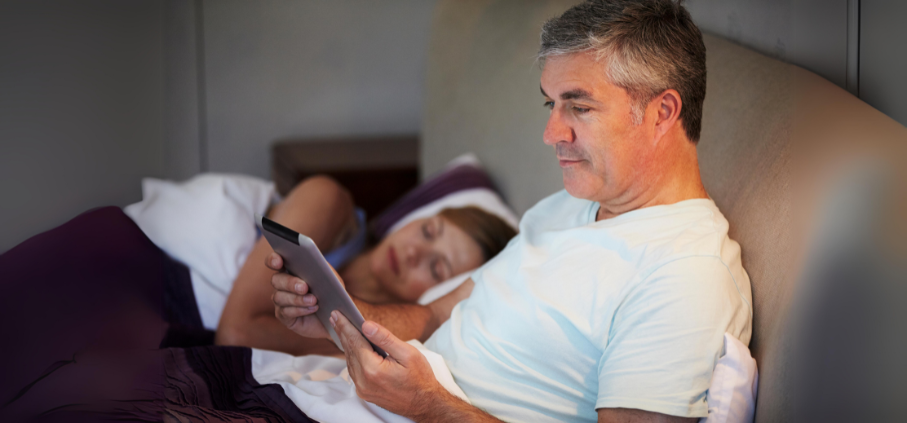
Many of us have heard that looking at our phones or iPads at night can keep us awake due to light exposure, however, research shows this may be true for children, but there is not sufficient evidence to support this claim for adults.
“Young children have a greater sensitivity to light because more light gets to the retina of a child than an adult,” says Jamie Zeitzer, PhD, Co-Director of the Stanford Center for Sleep and Circadian Sciences. “Since adults have more opacities in their eyes and smaller pupils than children, less light passes through adult eyes, so there’s less of an effect on melatonin production.”
Melatonin is a hormone that makes us feel sleepy and is released when the eyes perceive darkness. Conversely, when we see natural light in the morning, we feel more awake because light hitting our eyes stops the production of melatonin.
Given this logic, it would seem reasonable that looking at our screens (smart phones, computers, iPads, etc.) at night could delay melatonin production and inhibit our ability to fall asleep, but Dr. Zeitzer says this is not the case.
While darkness enables melatonin production, suppressing melatonin production works by the brain comparing the amount of light we receive during at night with how much we received during the day. It’s the shift from light to dark that cues the release of melatonin, which is why we start to feel sleepy after the sun goes down.
Since natural sunlight emits 10,000-100,000 lux of light and phone screens emit 25-50 lux under usual conditions at night, Dr. Zeitzer says the light from our screens doesn’t have much of an impact on the melatonin cueing process.
“There just isn’t that much light coming from your phone,” says Dr. Zeitzer. “As long as you go outside during the day and get exposed to the intensity of natural light then the amount of light from a screen in the evening most likely won’t halt the production of melatonin.”
Rather than light exposure, Dr. Zeitzer believes that what is keeping us awake is what we are watching on our screens. Millions of Americans stay awake at night scrolling on social media looking at page after page of emotionally activating content and writing posts that lead to likes, comments, and followers. Others stay up to play games on their phones or computers, all of which stimulate the dopamine reward system in the brain, which is the basis of addictive behaviors.
“In the past, when a television show ended, you turned off the TV and went to sleep because there was nothing else to do,” says Dr. Zeitzer. “But now you could watch Netflix, look at apps or play computer games all night because this entertainment has been commodified to engaged with it for as long as possible; it’s optimized to never stop playing and this is causing sleep deprivation.”
When watching screens before bed, Dr. Zeitzer recommends that we not only avoid content that could be distressing, but also content that could stir excitement within us.
“In order to fall asleep, we need to reduce stimuli exposure and calm our mind and body,” says Dr. Zeitzer. “Even if you’re watching something positive, if it stirs excitement, the brain will release dopamine, and over time we can develop a dopamine addiction, making staying awake playing games or on social media much more fun that going to sleep.”
Lastly, Dr. Zeitzer says that he can’t make a general statement that nighttime screen use negatively affects everyone’s sleep. For some, their addiction to games or apps could make falling asleep a challenge, while others may watch soothing nature videos on their phones to help them relax and fall asleep. Therefore, Dr. Zeitzer suggests that you take note of how screens are impacting your sleep health by asking yourself these questions: