This blog is part of the Stress Management newsletter. If you like this content, sign up here to receive our monthly newsletter!
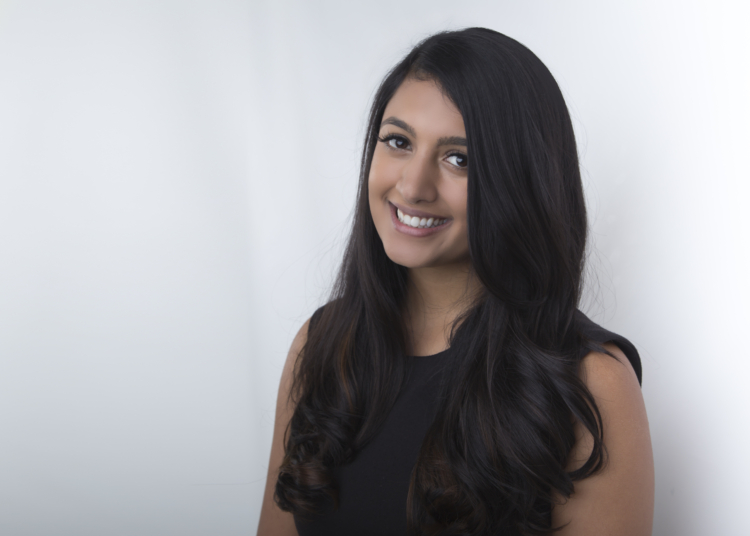
Vanika Chawla, MD, FRCPC, a psychiatrist, registered yoga teacher, and member of the Stanford Lifestyle Medicine Cognitive Enhancement pillar, has dedicated her career to improving mental health treatment through innovative and holistic approaches. Her distinctive background, combining both yoga and Psychiatry, offers a unique perspective on the potential of accessible stress management interventions.
“I view yoga as a novel lens for approaching mental health – one that can concurrently complement our existing treatment models and empower providers and patients to expand their therapeutic toolbox,” says Dr. Chawla.
Dr. Chawla works alongside Douglas Noordsy, MD, Assistant Director of Stanford Lifestyle Medicine, at Stanford Medicine’s Lifestyle Psychiatry Clinic. Leveraging her unique blend of medical and yoga expertise, she focuses on innovative approaches to psychiatric care that incorporate lifestyle changes and holistic interventions into her patients’ treatment plans. In addition to her clinical work, she is actively engaged in a 300-hour Yoga Teacher Training program offered through Stanford Yoga-X, which focuses on integrating yoga into health care in an evidence-based yet holistic manner.
“I am so happy to be at Stanford because they are thinking outside the box in terms of how we can support people and enhance their mental health,” says Dr. Chawla. “It’s really cool that I found a place to work that allows me to integrate my lifelong interests in yoga and healthcare.”
Dr. Chawla’s research interests are also centered around yoga as an intervention in mental health. “Yoga is definitely a big research area that has made a lot of progress in recent years, however, significant gaps remain in the current literature,” she says. “Future research is needed to deepen our comprehension of the intricate mechanisms of how yoga affects the brain and body.”
In residency, she was involved in research projects focused on using yoga to address anxiety in children. In 2022, she was one of two recipients of the inaugural Stanford Lifestyle Medicine Seed Grants, securing a $10,000 grant to further her research in the field of Lifestyle Medicine. The project, titled ACTIVATE, seeks to create a digital tool that helps individuals with mental health disorders and make positive lifestyle changes to enhance their psychological and physical well-being.
Originally from Peterborough, Canada, Dr. Chawla completed her undergraduate studies in health sciences at McMaster University in Ontario. Here, she began exploring her interests in the mental health field. Her journey took a pivotal turn during a volunteer trip to India that exposed her to yoga as a cultural practice. This encounter sparked her fascination with the practice, leading Dr. Chawla to complete her 200-hour registered yoga teacher training the following year.
“There is so much more to yoga practice than most people realize. There is such a big psychological and social component,” says Dr. Chawla. “It’s not just the postures. There’s breathing, meditation, ethics, values, connection, and community. It’s such a broad, diverse practice and I was really blown away by that.”
She pursued her medical degree at the University of Calgary and her psychiatry residency at the University of Toronto. During her residency training, she observed parallels between psychiatry, psychology, and yoga. “I began to see how yoga could address many unmet needs in our current mental health care models, bridging gaps where medications and psychotherapy may fall short,” says Dr. Chawla.
These interests led her to Stanford University, where she found many opportunities in the realm of lifestyle medicine and mental health.
Looking ahead, Dr. Chawla plans to continue exploring innovative ways to improve mental health interventions through research and medical practice, including best practices for incorporating yoga into clinical care. Her vision includes working with marginalized populations, delivering culturally-informed and trauma-informed care, and ensuring that these interventions are accessible to all. To reach these goals, she plans to continue the development of digital applications like ACTIVATE to reach a broader audience.
“Yoga is a comprehensive system that includes a lot of different practices: movement, breathwork, meditation, community, and more,” says Dr. Chawla. “Because of this, it can be tailored and adapted to what people need, to help people of all backgrounds manage their stress through avenues that work best for them.”







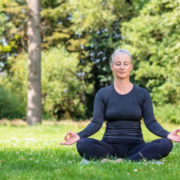
 A recent study called Treatments for Anxiety: Meditation and Escitalopram (TAME) compared an 8-week standardized evidence-based mindfulness-based intervention (mindfulness-based stress reduction, MBSR) with medication for the treatment of anxiety disorders. The study included over 200 adults with a diagnosed anxiety disorder that were assigned to either 8 weeks of the weekly MBSR course or taking a medication for anxiety called escitalopram. The MBSR course involved weekly 2.5 hour classes, 45-minuter daily home exercises, and a day-long weekend retreat during the fourth or sixth week. The classes and home exercises involved mindfulness meditation, body scans (directing attention to one part of the body at a time to increase inward awareness), and mindful movements such as stretching. At the end of the 8 weeks, the results showed that the mindfulness program was just as effective at reducing anxiety as medication.